
Ibusuki no Tamatebako seats: how to book the bay view from Kagoshima
Contents
For a view of Sakurajima, ask for a sea-side seat. Before picking a seat number, check which cars will run on your date. A spare car can change the choice. Car plans
Book a regular ticket with JR Kyushu · Find the rail pass booking service
Ibusuki no Tamatebako times and return trips
South runs from Kagoshima-Chuo to Ibusuki. North starts at Ibusuki and returns to Kagoshima-Chuo. All times are local.
| Train | Leave | Arrive | Ride |
|---|---|---|---|
| 1 · South | 09:56 | 10:47 | 51 min |
| 3 · South | 11:56 | 12:48 | 52 min |
| 5 · South | 13:57 | 14:49 | 52 min |
| 2 · North | 10:56 | 11:48 | 52 min |
| 4 · North | 12:57 | 13:48 | 51 min |
| 6 · North | 15:07 | 16:00 | 53 min |
Sources: No. 1, No. 3, No. 5, No. 2, No. 4, No. 6
Start at Kagoshima-Chuo, the city’s main station. Look for Ibusuki no Tamatebako on the Ibusuki Makurazaki Line. On Friday 27 November 2026, JR listed three trains each way. From Kagoshima-Chuo, No. 1 was listed from 09:56 to 10:47, No. 3 from 11:56 to 12:48 and No. 5 from 13:57 to 14:49. 1 3 413 14 15
For the trip back, the three scheduled departures from Ibusuki were 10:56, 12:57 and 15:07. They reached Kagoshima-Chuo at 11:48, 13:48 and 16:00 on the timetable. If you want time for lunch in Ibusuki, plan the return before choosing your outward seat. 1 416 17 18
For a different day, open the train calendar and tap your month. Then check the service notice for your section of track. The winter work notice names daytime trains between Ibusuki or Yamakawa and Makurazaki. Its December date is 16 December 2026. That notice alone does not cancel the ride from Kagoshima-Chuo to Ibusuki. 1 9 10
Read the two calendars before you choose a seat
JR gives you two answers in two different places. The operating calendar answers “Will this train run on my day?” The formation calendar answers “Which cars does JR plan to send?” Open the operating calendar first. A photo of an empty counter seat tells you nothing about an actual departure. Next open the formation calendar, find your month and day, and read the letter. Turn to page two of the same file. Match the letter to the drawing before looking at the seat plan. The calendar is a plan. A check on a car can still change it. 1 12
The dated timetable for Ibusuki no Tamatebako
November 27 is a good example of why the date matters. The general train page gives the usual afternoon departure as 13:56. The station board for Friday, November 27, and the page for that day's No. 5 both give 13:57. Its scheduled arrival is 14:49. Use the row for your day when the two pages differ. Do not move your whole day forward by one minute: the morning and noon trains have their own rows. Platform numbers, too, belong to a particular train and day. Check the board at the station before you go through the gate. 3 15
How much time do you really have in Ibusuki?
| Out → back | Arrive | Leave | Time in town |
|---|---|---|---|
| 1 → 2 | 10:47 | 10:56 | 9 min |
| 1 → 4 | 10:47 | 12:57 | 2 h 10 |
| 1 → 6 | 10:47 | 15:07 | 4 h 20 |
| 3 → 4 | 12:48 | 12:57 | 9 min |
| 3 → 6 | 12:48 | 15:07 | 2 h 19 |
| 5 → 6 | 14:49 | 15:07 | 18 min |
Sources: Outward schedule, Return schedule
Start with two times on paper: when the doors are due to open at Ibusuki and when your return train leaves. The gap includes getting out of the station, finding your way, any meal or visit, and getting back to the platform. It is not the length of time you can spend at a bath or a restaurant. If a place offers you a time, work back from your train before you accept. If you need more time, look for another return service while you still have a choice of seats. 13 16
Morning out, midday back
For two friends who want to ride together, No. 1 out and No. 4 back opens up a second seat choice. Try a pair of seats going down and two counter seats going back. Allow for walking and waiting before booking lunch. 13 17
Morning out, afternoon back
Taking No. 1 down and No. 6 back would give four hours and twenty minutes in Ibusuki, from 10:47 to 15:07. Of the three outward express trains, this one gives you the longest visit if you want the last scenic train home. It also means an earlier start in Kagoshima. A family that needs time to collect tickets, find the platform and settle a child may value that extra time at the station more than a long visit. Compare the noon departure with your plans before deciding that the first train is best. 13 18
A shorter stop after the noon train
No. 3 arrived at 12:48. No. 6 departed at 15:07, two hours and nineteen minutes later. That gives about as much station-to-station time in town as the morning-out, midday-back pair, but puts the visit at a different time of day. Check when the place you want to visit can actually receive you. If you plan to meet someone, give them the station arrival time and agree on a separate meeting time. The time on the ticket tells them when your train is due, not when you will be standing at their door. 14 18
When the afternoon ride is the activity
No. 5 took 52 minutes on November 27. The last scenic train back left at 15:07, just 18 minutes after No. 5 was due in. That is a short stop even if you know the station. If the main aim is to spend an afternoon in Ibusuki, search for a later regular train home or plan to stay the night. If your main aim is the train itself, ask whether seats are available in both directions before buying either journey. A ticket for the ride down does not give you a seat on the way back. 15 18
The nine-minute turnround
There were two pairs of trains just nine minutes apart at Ibusuki: No. 1 arrived at 10:47 before No. 2 left at 10:56, and No. 3 arrived at 12:48 before No. 4 left at 12:57. Neither gap is time for a town visit. Do not plan to stay in the same seat or assume that the return trip is included. Ask staff about boarding the return train and have that booking ready. With a wheelchair, a stroller or anyone who needs help, tell staff about the short gap before choosing the pair. 13 14 16 17
If Kagoshima is your connection
Work from the time you must leave Kagoshima-Chuo, not only from the time you want to leave Ibusuki. The last scenic return arrived at 16:00 on the checked day. A seat on that train may be a poor choice if you need an earlier connection. The midday return was due at 13:48. Write down both platform arrival and onward departure, then allow time to find the next gate and ask for help if needed. Use a fresh search for the onward trip. The ticket for Ibusuki covers only the journey printed on it. 16 17 18
The station name that matters
The departure station in this guide is Kagoshima-Chuo. Use that full name when you search and when you arrange a meeting. Tell a taxi driver or travel partner which station, train number and departure time you need. “The train to Ibusuki” might mean the sightseeing express or a regular train on the same line. If two people are meeting on the platform, exchange car and seat details once both tickets are in hand. Seats with the same number can be in different cars. 3 4
Read a Japanese departure list
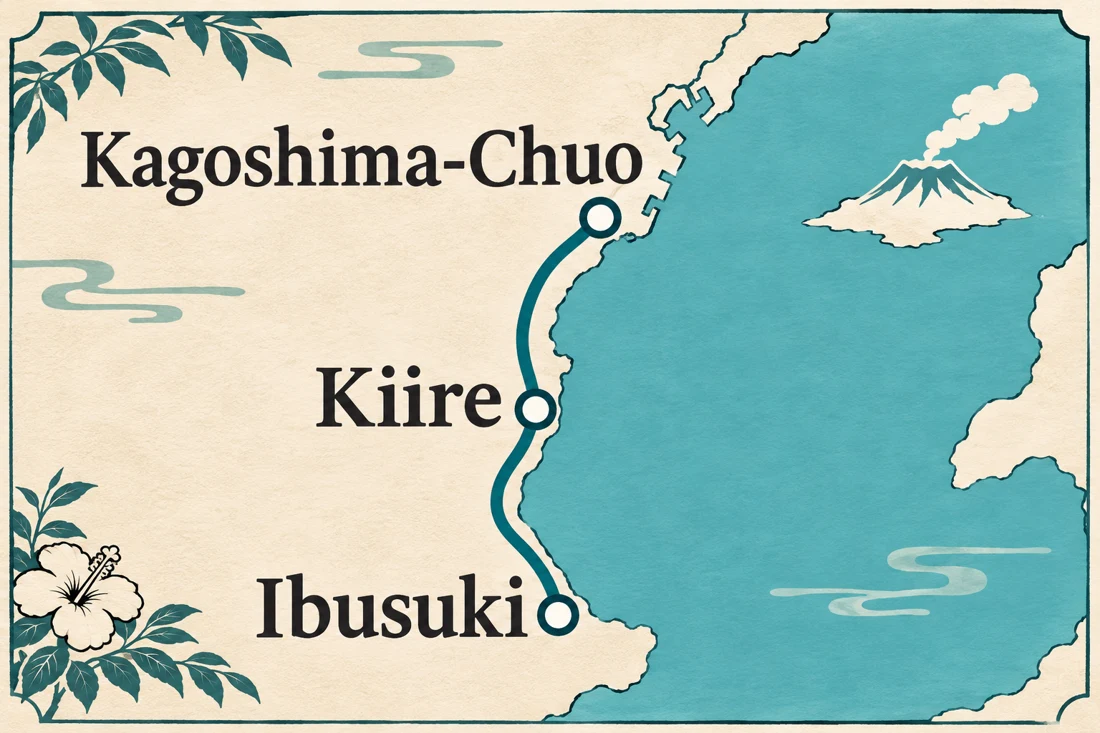
Look for 鹿児島中央 for Kagoshima-Chuo and 指宿 for Ibusuki. The long name 指宿のたまて箱 identifies the sightseeing train. The number after the name identifies the service, not the car you ride in. The train list at Kagoshima-Chuo also includes trains ending at 喜入, Kiire. That name is useful when you read the map but it is too early a stop if your destination is Ibusuki. Tap the individual train and look for 指宿 in its stop list. Do this even if its final destination is another town. 3
A work notice farther down the line
The name of the railway line covers a longer journey than this express makes. On JR's winter work notice, find the two stations that mark the work area, the specific day, and the services in the table. A through local train can serve Ibusuki while part of its trip farther south changes. If your destination is Ibusuki, check whether the train still reaches that station. If your destination is beyond it, check the second part as well. Do not plan on a replacement bus simply because part of the railway is closed; JR's notice for this work says there is no substitute bus for that section. 9
Plan the time between trains with our Kagoshima and Ibusuki day guide.
Ibusuki no Tamatebako seat map and car patterns
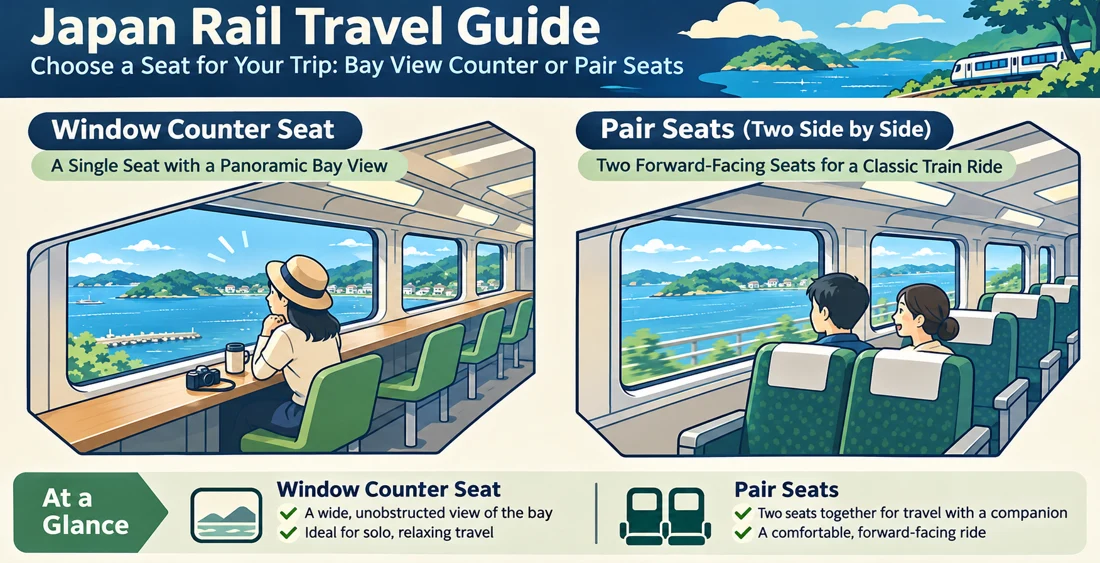
Ask for the sea side if you want to look across the bay toward Sakurajima. On the way south from Kagoshima-Chuo the water is on the left in the direction of travel. Going back it is on the right. A window seat on the inland side gives a different view. 1 2
Use the car plan as well as the seat number. In the regular second car, the sea-side chairs can turn toward the water. A counter seat lets you look straight out. Two seats beside each other may suit you better if you want to talk or help a child. 1 2
Before you pay, check the train formation calendar on JR’s train page. A spare car can join the train or replace car 1 or 2 during checks. It has no sea-facing counter seats. If the booking screen only offers a general seat choice, ask the ticket office to show you the plan for your train. 1
- Regular car 1
- 15A · 16A · 17A · 18A · 19A
- Regular car 2
- 11A · 12A · 13A
15A · 16A · 17A · 18A · 19A · 20A · 21A · 22A - November 27 · D formation
- Car 1 → spare car. No reserved counter or box.
Car 2 → regular car. Use the two runs above.
Match the letter to the two car plans
The drawings on JR's train page show the regular first and second cars. The letter on the calendar tells you which drawings to use. A is the regular two-car train. B keeps both regular cars and adds the spare as car 3. C keeps regular car 1 and uses the spare as car 2. D keeps regular car 2 and uses the spare as car 1. A coach number by itself is not enough. First ask “Which pattern?” Then ask “Which car?” Only then is a seat number useful. 12
November 27 worked example: pattern D
Find Friday the 27th in the November 2026 grid of JR's October–December formation PDF. The letter is D. On page two, the drawing for D puts the spare at car 1. That changes three booking decisions. For a seat facing the bay, look at the regular car 2 plan. For three or four people, do not count on the box in the regular first car; the D drawing says box seats are not sold. The same drawing says the accessible reserved seat is not sold in D. For help with a wheelchair, contact the staffed desk before choosing a train. 12
Regular car 2: how to read the counter numbers
Look across the sea side on the regular car 2 drawing. At one end you can see 11A, 12A and 13A. In the longer run, the printed numbers are 15A through 22A. The little boxes are seats along the window. A gap in the numbers is not an invitation to request an extra place between them. Point to an actual box on the map. To ask about two places beside one another along the counter, pick two neighbors in the same run, such as 17A and 18A. Ask whether both can be reserved on your date. 24
Regular car 1: a counter or a box?
In a regular first car the sea-facing counter is labeled 15A through 19A. The box seats are a different shape on the drawing, near the end toward Ibusuki. A box suits a party of three or four who want to face one another. JR marks the minimum group size as three. Two people wanting a table together should ask for other seats. For a family of four, request the box as a group and let the clerk check the train formation first. Four separate seats in your search results are not proof that one box is available. 23 12
What to ask if you have a wheelchair
JR directs requests for a wheelchair-accessible seat to a staffed Midori-no-madoguchi ticket office or its phone line, 0570-07-8787. The train page specifically excludes pattern D from that seat offer. If a general seat appears online on a D day, it does not settle whether your journey will work. Describe the help you need, the station where you will get on and off, the date and whether you will travel with a companion. Ask staff to check the actual train and boarding arrangements. Let them explain the options before you buy seats elsewhere in the car. 1 12
A seat beside the window versus a seat facing the window
A rider looking straight out of a counter window can keep their gaze on the water without turning sideways. In a pair of ordinary seats, the person next to you may be the main reason for choosing the pair. Think about what you will do during those 51 to 53 minutes. Will you take photos, chat, help someone with a snack, read to a child or give someone a hand when standing up? A counter and a pair can both be good choices. Tell the clerk the feature you need rather than asking only for the “best seat.” 1 2
The same seat number can mean two different requests
Compare 17A in the regular first car with 17A in the regular second car. The number alone leaves the clerk to guess which car you mean. On a D day the regular first car is missing altogether. Write the request in this order: date, train number, direction, car, then seat. If the first choice has gone, decide whether you would change the number, the car, the departure, or the day. Keeping the day and choosing a different chair may be easy. Changing departure could remove the time you need for your visit in town. 23 24 12
Small windows and stars
JR puts a star beside some seats on the official car drawings and explains that their windows are small because of the car design. If a broad view matters more than sitting at a particular end, show the clerk the star on the plan and ask for an alternative. Read this mark separately from availability. A blank seat on a layout tells you how the coach is built; only the reservation system or a clerk can tell you if it is free. Seeing the shape of a window is useful even before you know whether you can book the chair beside it. 23 24
The spare car's shared space
There is a detail in JR's descriptions that is easy to miss. The spare car can have a shared sofa and counter table in its middle, yet it does not have the individual sea-facing counter seats sold in the regular cars. Those two things can be true at the same time. When asking staff about the spare, say whether you mean an assigned travel seat or a place you can visit for a look. Do not plan a whole journey around finding a free space empty. Choose a booked seat you will be happy to use. 1 12
A solo rider choosing between two directions
If the outward counter is full, ask for the sea-side layout on the return before changing your whole day. You can use the outward ride to sit back and see where the line runs close to the water. Coming back, the bay is on the opposite side in the direction of travel. Use “sea side” with the direction and train number so your question still makes sense to someone reading the car plan from the other end. If your return is already fixed, keep that time in front of you while checking seats. 1 2
Two people taking pictures
Two neighboring counter seats put both people at the window but facing outward. A pair of chairs arranged for conversation gives the two of you a different ride. Decide this before one person books on behalf of the other. If one person wants to watch the bay while the other needs help getting up, ask where the aisle and doors are relative to each proposed place. Use JR's plan to point, rather than saying “left seat” to someone facing you. A single screen capture of the plan plus the train date helps make the request clear. 1 2
Four friends with different priorities
Imagine two friends care about a photo and two want to sit around a table. Before booking, agree whether splitting up is acceptable. If the train has regular car 1, ask about a box for all four. If it is pattern D, ask about two pairs or some counter seats in regular car 2. If you do split, agree to meet again at Ibusuki station. A seat plan can help you locate one another, but it cannot turn a shared sofa elsewhere in the car into four extra numbered travel seats. 12 23 24
Choosing a day by the formation
If the box or accessible seat is essential and your date is flexible, start with the calendar letter rather than with a favorite departure time. For example, the published calendar showed D on November 27 and A on December 21, 2026. The first date points to the spare first car. The second points to the regular first car. Moving the trip to a different day changes what you can ask for; it does not guarantee the seat is available. Run a new train search for that second day or ask the ticket office to check it. 12
To visit the volcano itself, see how to take the Sakurajima ferry.
How to book Ibusuki no Tamatebako tickets
Planning examples use the regular-season single fare and the ¥1,170 adult local fare seen in the November 28 search. Totals are per party; check both travel dates before paying.
| Adults | Express one way | Express both ways | Express out, local back |
|---|---|---|---|
| 1 | ¥2,950 | ¥5,900 | ¥4,120 |
| 2 | ¥5,900 | ¥11,800 | ¥8,240 |
Sources: Regular-season express fare, JR ticket search
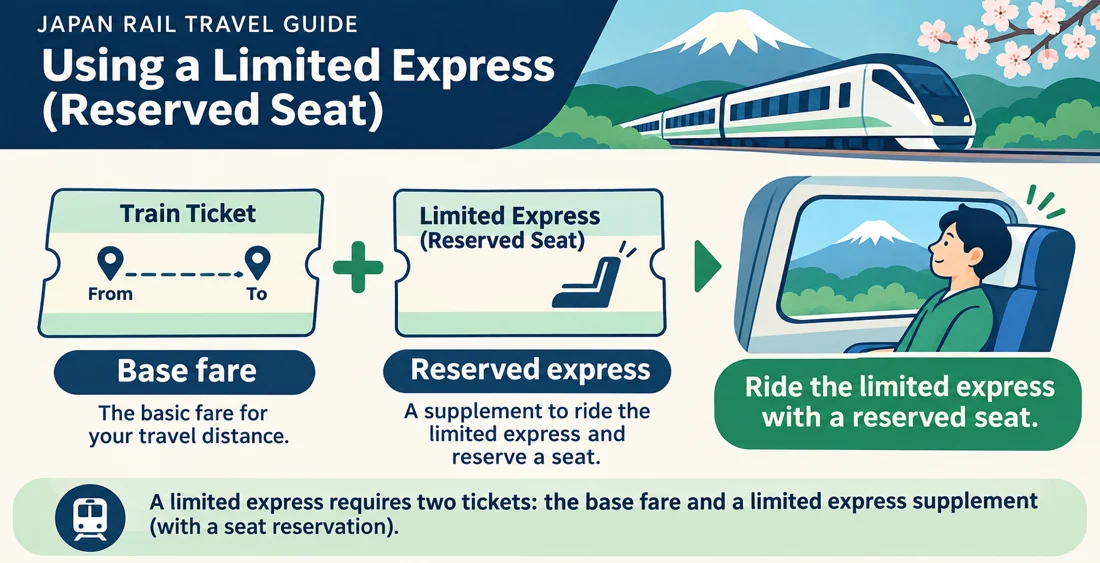
JR lists ¥2,950 for one adult from Kagoshima-Chuo to Ibusuki, one way, at the regular-season rate. This total covers the basic fare for the journey and the reserved limited express charge for this train. Check your travel date for the price you will pay. 1
Every seat is reserved. Pick the date, direction, train and number of riders before you board. For a regular ticket, use JR-Kyushu Train Reservation. If you use a JR Kyushu Rail Pass, choose the pass booking service from the ticket purchase page and check your pass coverage. 1 5 6
Regular online reservations open at 10:00 Japan time one month before departure. Pick up the tickets before boarding. Bring the card used to pay, the five-digit booking number and the four-digit ID you chose. Leave time to use a reserved-seat machine or visit the ticket office. 5
Search for the right destination in English
Open the regular JR-Kyushu Train Reservation site if you are buying an ordinary ticket for this ride. In the From box choose KAGOSHIMA-CHUO. In the To box start typing IBUSUKI. Select IBUSUKI from the suggestion that appears under the box. In our test, entering the letters without selecting the suggestion led to a message to enter the destination. If that happens, go back, select the suggested station and try the search again. For the trip back, swap the station names and check them before reading any prices. 5 22
Choose a time before the departure you want
If you want No. 1, start the search a little before 09:56. A search starting much later in the day can show only regular trains even though the scenic train ran that morning. On the results page read the date, direction and passenger count at the top. Then read the name and times in each row. A train on the Ibusuki Makurazaki Line can reach exactly the same station as the sightseeing express. The words Ibusuki-no-Tamatebako and the service number identify the ride for which you need a reserved express seat. 3 22
What the booking engine actually showed
At 14:12 Japan time on November 27 we searched the English site for one adult traveling the next morning, November 28, from Kagoshima-Chuo to Ibusuki. The result included No. 1 at 09:56, arriving at 10:47. Its reserved seats showed a cross and “Full.” The surrounding rows were the 09:17 local arriving at 10:29 and the 10:02 local arriving at 11:29. Both showed ¥1,170 for an adult and ¥580 for a child. These are a dated example of what the screen means. Repeat the search for your passengers and date to see what is available then. 22
Why there is no reserve button on the local row
In that same search, the site said that a journey using only local or rapid trains could not be reserved there. This is a different answer from the word “Full” beside the sightseeing train. It means the regular train in that row is outside this online seat reservation option. It gives you a practical alternative: note the local train time, then ask how to buy the basic fare or use a valid pass at the station. If you want a reserved ride on the sightseeing train, look at another express departure. Clicking a local row will not open its sea-side seat map. 22
How to compare the two prices
For the regular-season example, the scenic ride is ¥2,950 one way. The local ride in the dated search showed ¥1,170 for an adult. The difference between those two amounts is ¥1,780. Treat this as a comparison for planning rather than a separate payment to make after buying the full express ticket. Paying ¥2,950 already covers both parts at that quoted rate. Ask for a total for the actual date and ticket type. If you already hold a pass, tell the clerk which pass it is before comparing the amount you would pay out of pocket. 1 22
Time saved depends on which train you compare
For the November 28 search, the first scenic train took 51 minutes and the 10:02 local took 87 minutes. The scenic ride itself was 36 minutes shorter. The two trains also started six minutes apart. If you compared their arrivals instead, the gap was 42 minutes, from 10:47 to 11:29. That six-minute difference matters when deciding whether to wait for a train at the platform. The earlier 09:17 local in the same search arrived at 10:29, before the scenic train. The fastest ride and the earliest arrival are two different questions. 22
What one adult should budget
If you buy only the outward sightseeing journey at the regular-season example price, put ¥2,950 in the train budget for that adult. If both directions carry the same regular-season amount, two single journeys add up to ¥5,900. This is simple addition, not a special return offer. For a mixed trip using the local fare seen in the search, ¥2,950 plus ¥1,170 comes to ¥4,120. Use those three totals to compare your choices: one sightseeing ride only, a scenic ride in both directions, or a scenic ride one way and a local the other. Add visits and onward travel separately. 1 22
When two adults pay together
For two adults, a one-way trip on the local costs ¥2,340 at the example rate. Check the total and both seat numbers before paying. Two available seats can be in different rows or even different cars. 1 22
Ask about a child's own seat
A family price starts with who will occupy each numbered seat. The ordinary child rate for the basic fare and reserved express charge is generally half the adult amounts, subject to JR's rounding. Do not halve the displayed combined total and promise that number to everyone in the party. If a preschool child needs a reserved seat of their own, tell the clerk that when you ask for the total. If a baby will be held by an adult, describe that instead. Give the ages and how many young children are traveling with each paying rider. Ask the clerk to confirm the fare before choosing a layout. 7
Work back from the ticket pickup
Booking online is one task; picking up the ticket is another. Write down the five-digit reservation number and keep the four-digit ID you chose available to you. Bring the actual credit card used for that booking. A photo of a seat plan is handy at the counter, but it is not a substitute for what JR asks you to present. If someone else plans to pay, read the pickup conditions together before using their card. Decide who will collect the ticket and whether the necessary card will be with that person on travel day. 5
If the train is close to departure
The regular online service gives a cutoff of six minutes before departure for making a reservation, within its operating hours. Treat that as a system deadline, not a sensible target for arriving at the station. You may still need to select a station suggestion, choose a ticket, finish payment, collect it and find the platform. If you are at the station and short on time, tell a clerk which train you want and ask whether there is time to board. If the answer is no, compare a later departure with a local before buying any express ticket. 5
A rail pass is a separate booking route
JR's English ticket-purchase page offers one link for regular tickets and another for JR Kyushu Rail Pass bookings. Start by reading the exact name on your pass or voucher. A family with two different passes should check each one. A paid ticket search is useful for comparing times, but its price is not proof of what your pass covers. Ask how to reserve the seat with that pass and what you need to show on board. Because this is an all-reserved train, settle the reservation before going through the gate. For a local-only ride, ask separately how to use the pass for that section. 1 6
Ibusuki no Tamatebako with children or a wheelchair
If a young child needs a seat of their own, include the child when you ask for seats. JR charges the child fare when a baby or preschool child uses a reserved seat alone. For a child ticket, the basic fare and express charge are generally half the adult amounts, with JR’s rounding rules. 2 7
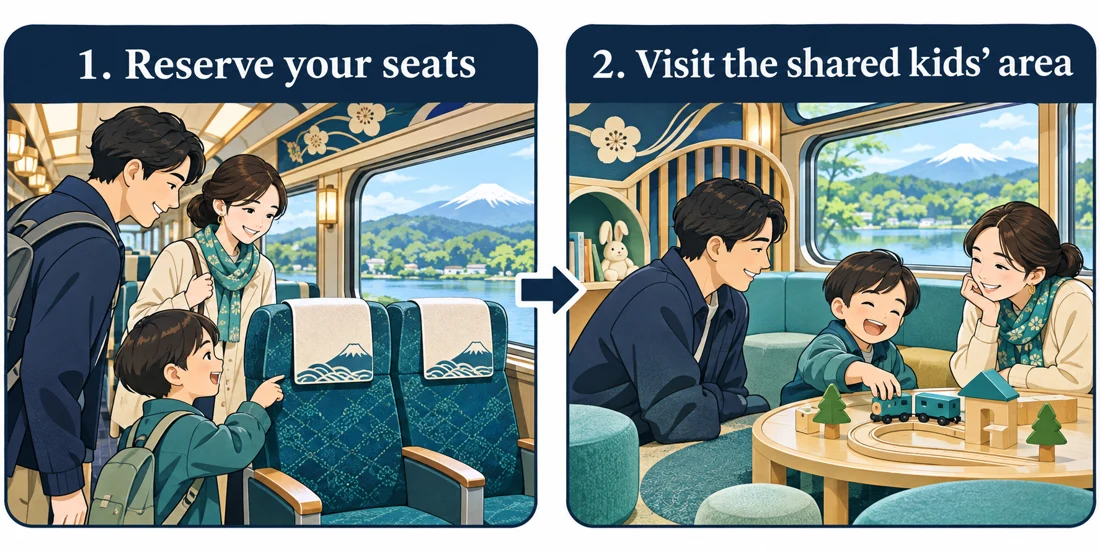
For a first ride with a small child, ask for two travel seats together. Look for the low children’s counter or bookshelves on the regular car plan if you want somewhere to visit during the ride. Keep your booked seat numbers handy so you can find your way back. 1 2
Try this at the ticket office: “Two seats together, please. Is there a pair on the sea side?” If that pair is taken, decide whether staying together or facing the bay matters more. Ask about the same seats on the return trip before giving up on the view. 1
Pick the seat where the child will spend the journey
Picture the first five minutes after boarding. You have a bag in one hand, a child with you and a seat number to find. Will it be easier to sit beside the child, or to sit at separate chairs along a long window? Answer that question before you look at pictures of the play space. On the regular second car, the kids' chairs and the baby area are shared spaces. Your family might visit them after settling in. When another family is using the space, you can enjoy the ride at your own booked seats and decide later whether to walk over. 1 7
Three people who want to sit around a table
For three travelers, start with the regular car 1 box if the day's pattern includes that car. It meets the stated minimum of three, and it lets the group face one another. Ask what the clerk needs to issue the seats together. If the third traveler is a preschool child or baby, explain the child's age and whether you intend to buy them their own seat. Let the clerk confirm eligibility and price for that actual party. Do not assume that counting three bodies at the station automatically meets every condition for a three-person reservation. 1 7 23
If the kids' area matters more than the box
Suppose your two children are hoping to see the small chairs by the window. The children's area and the family box belong to different regular cars. On an A or B formation you can ask about either. On a D day the regular second car is present but the first-car box is not offered. A parent can choose ordinary travel seats together and plan a short look at the children's space when it is free. Explain this to the children before boarding so they do not expect to spend the whole ride in a particular shared chair. 1 12 24
If two families want to travel together
Make a list of the people who must sit next to each other and those who would like to sit nearby. A young child and their adult may be the first pair to place. Two adults who can sit separately might take remaining places in the same car. Give the clerk the full group size and the minimum arrangement you can accept. Check each car and row on the printed tickets. Agree where to meet at Ibusuki if the party ends up in more than one car, and have one adult keep track of the return train time. 1 23 24
Planning for a companion who needs support
A wide view will not help much if the seat arrangement makes the ride hard for your companion. Ask which car, which entrance and which seats staff suggest for the help you describe. The regular first car drawing marks a wheelchair space; its usual number on a drawing is not proof that the same car is on today's train. Mention whether you need a companion seat and whether you have booked the trip back already. If your first choice is pattern D, let the staff member suggest another workable option. Keep their instructions with the ticket rather than relying on a general photo of the cabin. 1 12 23
Missed Ibusuki no Tamatebako? Compare the next locals
| Missed service | Local departs | Ibusuki arrival | Later than booked |
|---|---|---|---|
| No. 1 · 09:56 | 10:02 | 11:29 | 42 min |
| No. 3 · 11:56 | 12:02 | 13:19 | 31 min |
| No. 5 · 13:57 | 14:02 | 15:28 | 39 min |
Sources: 10:02 local, 12:02 local, 14:02 local
Show your tickets to station staff. For an ordinary reserved express ticket, a missed departure does not give you a reserved seat on the next train. JR’s same-day rule for unreserved express seats is of little help here because every seat on Ibusuki no Tamatebako is reserved. Ask the price of a new reservation if you still want the sightseeing train. 3 8
If getting to Ibusuki matters more, look for a local train that reaches Ibusuki. On the 27 November timetable the 10:02 local for Makurazaki followed the 09:56 sightseeing train. A train ending at Kiire stops short of Ibusuki. Show staff your basic fare ticket or pass before buying another ticket. 1 3 8
If the delay affects the line itself, check both trains before changing plans. A local uses the same line. Check its last stop and ask whether it will reach Ibusuki that day. If you are continuing past Ibusuki, check that part of the journey separately. 3 9 10
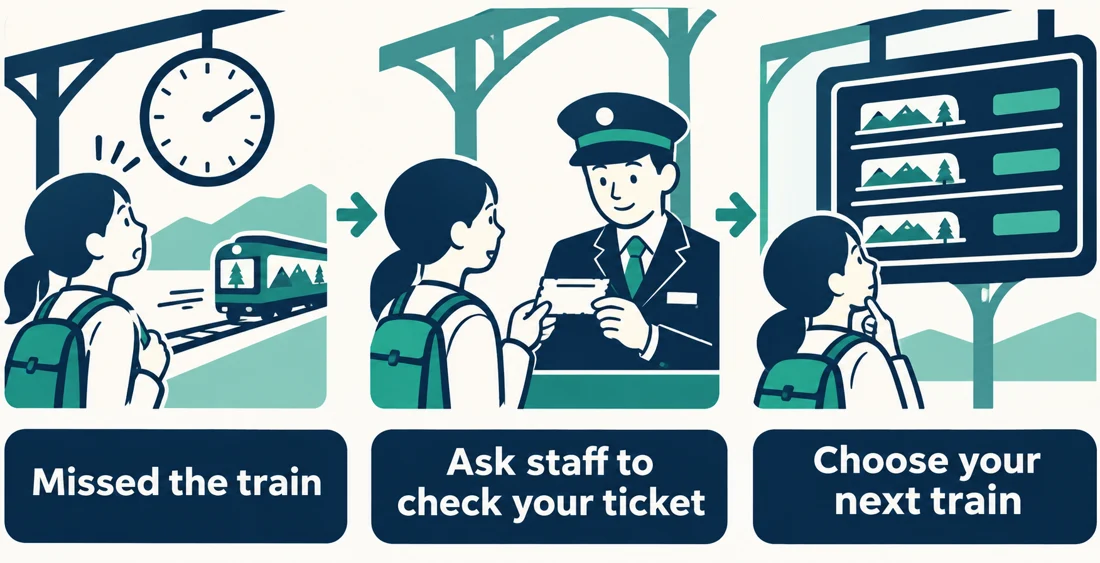
If you reach the gate as the train leaves
Stay together and show staff both parts of the ticket or your pass and seat reservation. Say where you still want to go and whether reaching Ibusuki quickly matters more than taking the named sightseeing train. The first answer you need is which trains will take you there. The next is what your particular ticket covers now. A seat assignment carries the train number: an empty-looking chair on a later express is not a replacement reservation. If a later scenic train is the only ride you want, have staff check availability and the cost of a new seat first. 1 8
Missed No. 1: compare arrival times
On November 27, No. 1 left Kagoshima-Chuo at 09:56. The local at 10:02 went to Makurazaki and was due at Ibusuki at 11:29. The next sightseeing express, No. 3, was not due at Ibusuki until 12:48. Taking the local would have brought a passenger there 79 minutes earlier than waiting for that express. That calculation assumes you can reach the local platform in time and the service runs to schedule. If the six-minute gap has already gone, ask about the next train that actually reaches Ibusuki. The next departure on the line may end at Kiire. 13 14 19
Missed No. 3: protect a lunchtime meeting
The 11:56 express was scheduled to reach Ibusuki at 12:48. The 12:02 local was due there at 13:19. Those arrival times are 31 minutes apart. If someone is waiting to meet you, send them the new train's arrival time once staff confirm you can take it. The 13:57 scenic train would arrive at 14:49, 90 minutes after the local. Waiting may suit a visitor whose main purpose is the train, but it would be a poor fit for a meeting soon after lunch. Tell the clerk which choice you prefer before asking about a new express ticket. 14 15 20
Missed No. 5: check the return before leaving town
After the 13:57 scenic departure, the 14:02 local to Yamakawa was due at Ibusuki at 15:28 on November 27. The last scenic train back was scheduled to leave Ibusuki at 15:07, 21 minutes before that local arrived. If you had booked that scenic return, taking the local south would not save the original round trip. Show both bookings to the clerk while you are still at Kagoshima-Chuo. Decide whether to choose a later ordinary train home, make a different visit or keep your afternoon in Kagoshima. Check the rules for the unused return before its departure. 15 18 21
When JR reports trouble rather than you arriving late
If the railway is delayed or a train is canceled, tell the clerk what happened before changing a ticket yourself. A missed train because you arrived late and a missed connection because of a railway delay are different situations under JR's ticket rules. Keep any tickets you already hold and ask which conditions apply. Use the live service page as a starting point. A broad warning for Kagoshima covers more than this one route. Read the line name and both ends of the section, then check the station departure display for your own train. 8 9 10
When the only fast option ends at Kiire
Look up the stopping pattern before you step onto the platform. A service ending at Kiire can take you along part of the line but it cannot carry you all the way to Ibusuki on that same train. If someone suggests changing at Kiire, ask them to show you the second train and its arrival time. Compare that with waiting for a later direct train from Kagoshima-Chuo. With children or limited mobility, a direct ride with a later departure might be the easier journey. Count the transfers as well as the minutes before choosing. 3 19
Keep the return booking separate
A change on your outward journey can make the return impossible even if the return train is running normally. Write down the latest time you can leave your activity and still reach Ibusuki station comfortably. After a late arrival, calculate it again. If you would need to turn back at once, speak to staff before using the outward ticket. If the return still works, keep its details separate from any new ticket for the outward trip. Check the train number carefully when you show a booking to a clerk so the change you request concerns the right journey. 4 8 18
Ibusuki no Tamatebako booking FAQ
Which seats can a family book, and where can children play?
JR lists it for three or four. For two, ask about nearby counter seats or a pair of chairs. Pattern D has no box for sale. 1 12
The kids’ chairs are shared. First arrange the tickets and travel seats your family needs. Use the play area when it is free during the ride. 1 7
Which seat numbers face the bay on a D day?
Ask for regular car 2, numbers 11A through 13A or 15A through 22A. Check availability for your departure. Car 1 is the spare car on D days. 12 24
How long is the ride, and when is the last scenic train back?
On November 27 the southbound trips took 51 or 52 minutes. The final scenic return left Ibusuki at 15:07 and reached Kagoshima-Chuo at 16:00. 13 14 15 18
What if the screen says Full?
Compare a later sightseeing departure with the next local that reaches Ibusuki. For a local-only trip the regular booking system can show a fare even though you cannot reserve a seat there. 3 22
Can I reserve a wheelchair seat through the ordinary seat list?
Ask at a staffed JR ticket office or call 0570-07-8787. JR excludes D from the wheelchair seat offer. Describe your date, direction and boarding needs before choosing another train. 1 12
Plan your trip with JR Kyushu
- Train calendar, fares and car plans
- Cabin guide in English
- Kagoshima-Chuo departures
- Ibusuki departures
- Online booking and ticket pickup
- Ticket and rail pass booking options
- Child fares
- Missed trains and ticket changes
- Winter track work south of Ibusuki
- Service updates
- Delay records from Kagoshima-Chuo to Yamakawa
- Oct–Dec 2026 formation calendar
- November 27, train 1
- November 27, train 3
- November 27, train 5
- November 27, train 2
- November 27, train 4
- November 27, train 6
- 10:02 local train details
- 12:02 local train details
- 14:02 local train details
- JR regular ticket search
- Regular car 1 numbered plan
- Regular car 2 numbered plan

