
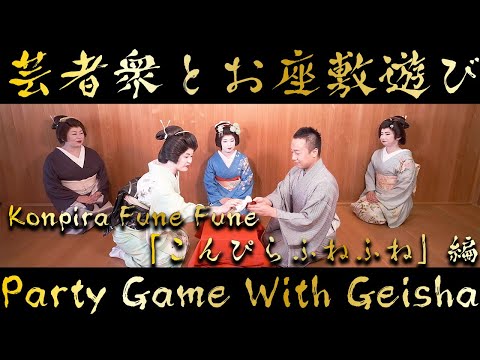
 Kan Nishikawa: Konpira Fune FunePublisher or venue information
How to Play Ozashiki Games: Konpira Fune Fune and Tora Tora
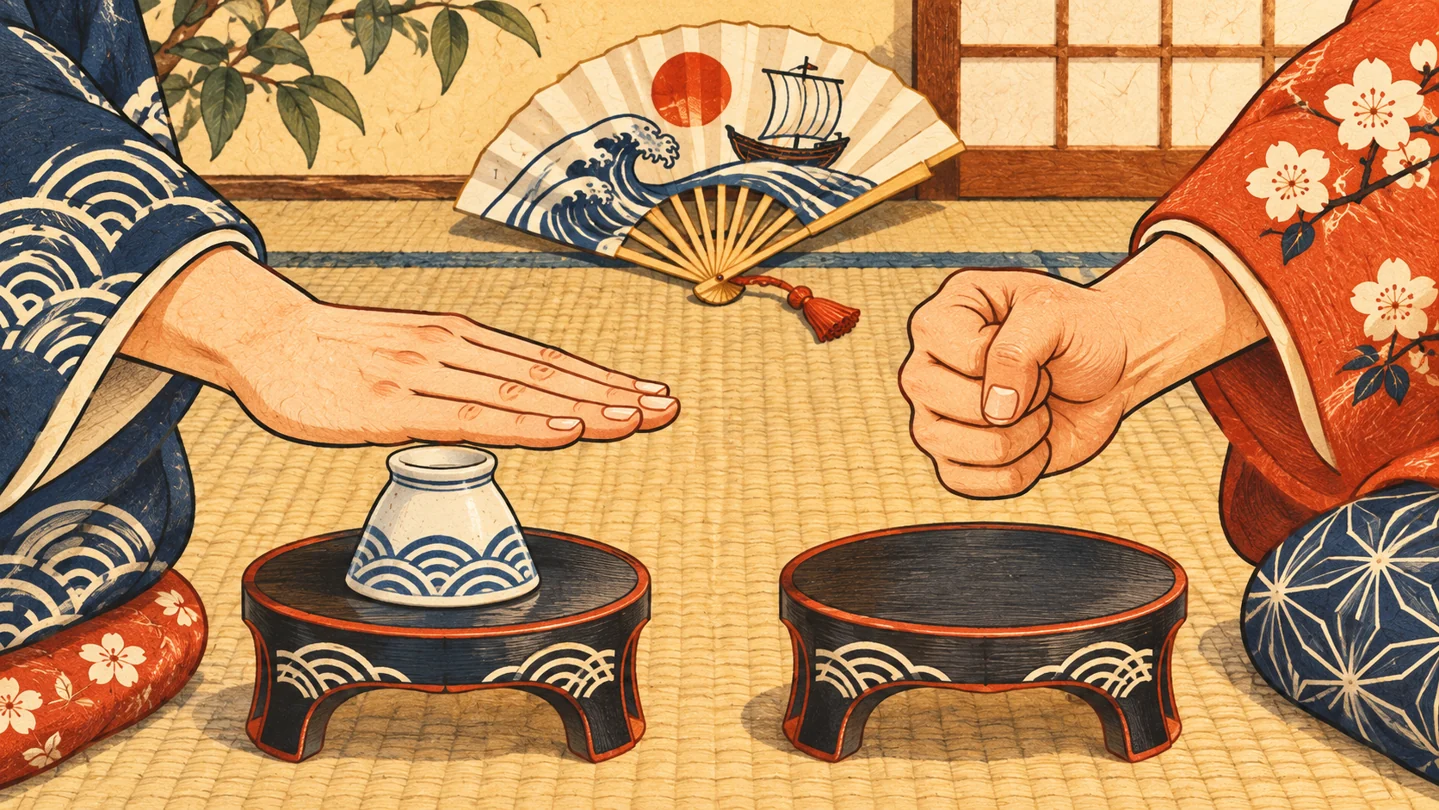
In Konpira Fune Fune, use an open palm when the little prop is on the stand and a fist when the stand is empty. In Tora Tora, step out from behind a screen as a tiger, an old woman or the hero Watōnai. These are two games you might be invited to play at an ozashiki, a gathering where geisha entertain guests. Learn the two moves below, then check whether the programme you want to book lets guests join in.
On this page
| Game | What to watch | Your move |
|---|---|---|
| Konpira Fune Fune | Whether the prop is on the stand | Use an open palm or a fist on your beat |
| Tora Tora | The musical cue and the pose across the screen | Pick one of three characters and reveal your pose |
How to play Konpira Fune Fune
Sit facing your opponent. A small prop called a hakama sits between you. At Miyakodori in Asakusa, it rests on a low armrest called a kyōsoku. The players take turns as a song and shamisen set the beat. Watch the stand as well as your opponent's hand. Miyakodori’s archive on ozashiki games
Which hand shape goes on the stand?
- Prop is on the stand
- Touch it with an open palm or pick it up.
- Opponent has the prop
- Tap the empty stand with a fist.
- You have the prop
- Put it back on your beat. Your opponent switches to an open palm on the next beat.
When you are holding the prop, you can put it back on one of your turns. If your opponent is still holding it when your turn comes, tap the empty stand with your fist. You lose the round if you use the wrong hand shape for what is in front of you.
A common switch. You touch the prop with an open palm. On the next beat, the other player lifts it away. Your hand has just been open, so it is easy to repeat the movement by habit. Look again. The stand is empty, so tap with a fist. If the other player puts the prop back on their turn, switch back to an open palm.
In this demonstration, watch what happens immediately after one player lifts the prop. The other player's next move shows how the two hand shapes fit the rhythm. Japanese dance performer Kan Nishikawa and geisha demonstrate Konpira Fune Fune
Practise the change that catches beginners
Set a light cup upside down on a flat surface and sit across from a partner. Pick something you can cover easily with one hand, since a cup that is too wide turns the exercise into a scramble. One person calls a steady count. Take one turn each, alternating throughout. In the first practice round, leave the cup in place and tap it with an open hand. When that feels easy, give one player permission to lift it. This makes your partner read the table before deciding which hand to use.
Try these four short sequences in order. Each row starts from the state named in the first column. The result tells you what changes for the next player.
| Start of the sequence | First player | Second player | Next move to practise |
|---|---|---|---|
| The cup is on the table | Touch it without moving it | Touch it with an open palm | Keep alternating while the cup stays there |
| The cup is on the table | Pick it up | Tap the empty spot with a fist | Keep your fist ready until the cup actually comes back |
| The first player is holding the cup | Put the cup back on the next turn | Touch it with an open palm | Check the cup after it lands before opening the hand |
| The cup is back in place | Pick it up on your turn | Use a fist on the next beat | Once both players can lift the cup, either player can start the change |
Now let the second player decide when to return the cup. If they keep holding it, the first player has another turn at the empty spot. Follow the object each time. The next beat does not automatically switch back to an open palm.
One common error happens just after a return. Imagine that you used a fist successfully in the last round. Your partner now puts the cup back. A fist feels like the safe choice because it just worked. The piece is already on the stand, though, so lay down an open hand. Another error happens when you start chasing the moving hand. As your partner takes the piece away, focus on the location where the cup had been. Aim the fist there gently when your beat comes. That gives you a fixed point to look at even when the music speeds up.
Miyakodori’s archive describes a limit on taking the piece repeatedly, with up to three successive takes in the version it records. The Anjo association teaches the open-hand and fist sequence with a sake-bottle base or another small cup that fits under the palm. Use those accounts to recognise the move, then let your host establish what counts as taking the piece, when someone can put it back and when a round ends. A practice sequence at home does not have to reproduce every rule used at the venue. Miyakodori’s account of the Asakusa game · Anjo Geiko Association’s hand-game instructions
- Watch where your partner's hand arrives.
- Check whether the piece stays there when their hand leaves.
- Set your own hand shape before your beat.
What the song has to do with boats
The name combines Konpira, a familiar name associated with Kotohira-gū in Kagawa, and fune, the Japanese word for a boat or ship. The song calls to mind a voyage by sail toward Konpira, a shrine visited by people praying for safe passage at sea. Think of a boat carried forward by a favourable wind. That image helps make sense of the repeated name and buoyant rhythm when you first hear the song. It also explains why a Kagawa shrine comes up in a game you might play in Tokyo or Fukui. Kagawa Prefectural Library’s reference entry on the song · Maritime offerings connected to Konpira at Cultural Heritage Online
The library’s reference entry brings together accounts of the tune as a travelling song and as a piece sung at gatherings. In the game, the singer and shamisen set the beat. Listen for the pace of the line and watch the exchange of turns.
Kotohira also shows how the rhythm game can move out of a banquet room. The local tourism association lists June 13, 2026, for a competition at Kotohira Town Public Hall. Its programme described a team league and a closing performance. The organiser marks the event as ended. Someone interested in a future competition would look for a fresh event announcement. Someone planning a private ozashiki should ask the host about that room’s rules. The association’s historic tournament notice serves a different purpose from a booking form for either visit. The Kotohira association’s record of the 2026 event
- Song
- The regional library traces accounts of the boat song.
- Game
- A host can show you how the hand movements fit the music.
- Tournament
- The Kotohira association's notice records a separate team event.
See the original footage
Kan Nishikawa: Konpira Fune FunePublisher or venue information Miyakodori: Tora Tora behind the screenPublisher or venue information
More from performers and visitors
How to play Tora Tora
The two players start on opposite sides of a folding screen, out of sight of each other. When the song reaches its cue, both step out in character. The Anjo Geiko Association shows the tiger with a roaring gesture, the old woman leaning on an imaginary walking stick and Watōnai holding an imaginary spear.
| Your character | The pose | You beat |
|---|---|---|
| Tiger | Make a roaring gesture | The old woman |
| Old woman | Lean on an imaginary walking stick | Watōnai |
| Watōnai | Take a spear-holding stance | The tiger |
Who wins? Follow the arrows.
- Watōnai → Tiger
- The warrior overcomes the tiger.
- Tiger → Old woman
- The tiger overcomes the old woman.
- Old woman → Watōnai
- The old woman overcomes the warrior.
Try a round. You choose tiger and your opponent chooses the old woman. You win. Choose tiger again and face Watōnai, and your opponent wins this time. Two players showing the same pose draw. If you cannot remember the whole loop, ask the host to demonstrate the poses and explain the cue before the first round.
Learn the roles by the movement you will make
Tiger. Anjo’s explanation names the roar. In the Kanazawa Asanogawa Enyukai Hall version, the tiger comes out on all fours. The posture matters if you are dressed up or find it easier to keep your balance standing. Ask the host to show the local movement and agree on a standing gesture if you need one. Anjo’s tiger pose · Asanogawa Enyukai Hall’s local description
Old woman. An imaginary walking stick identifies this role. The old woman beats the spear carrier. In Miyakodori’s account of the story, the hero can overcome the tiger but yields to his mother. Remembering that relationship helps when the winning cycle is new to you.
Spear carrier. In Anjo and at Miyakodori, the character is Watōnai. Miyakodori connects him with Chikamatsu Monzaemon’s puppet play The Battles of Coxinga. Kanazawa’s hall names its spear carrier Katō Kiyomasa. Look for the spear gesture in either account. Miyakodori’s account of Watōnai · Kanazawa’s role names and rules
- Anjo and Miyakodori
- Watōnai.
- Asanogawa Enyukai Hall, Kanazawa
- Katō Kiyomasa.
- Result in both accounts
- The spear role beats the tiger and loses to the old woman.
Follow the cue through a whole round
First, stand where the screen hides your chosen pose. The song gives both sides something to follow. Watch the person guiding you and wait for the agreed moment before stepping out. In a rehearsal with a friend, take turns calling the reveal while both players decide their own role. Once you step out, hold your movement long enough for the other player and the people watching to recognise it. At some gatherings the host will demonstrate beside you. In Miyakodori’s account, two guests often play while geisha show the moves on each side.
| What each person shows | Outcome | What to focus on the next time |
|---|---|---|
| You show the walking stick, your partner shows the spear | You win as the old woman | Remember the relationship between the two people in the story |
| You show the spear, your partner shows the tiger | You win as the spear carrier | Keep your eyes on the pose opposite you after the cue |
| You both come out as tigers | A draw | Return behind the screen and wait for the host to begin the next exchange |
| You show a tiger, your partner shows the walking stick | You win as the tiger | Separate choosing a role from recognising who won |
Try being the person who announces the result before playing a round yourself. Say the name of each role, then name the winner. In an actual gathering this is also a way to take part if somebody else wants the first turn. A family can let two people try the poses while the rest watch and learn the results. If the host has room for another exchange, swap roles and give someone else a turn. Agree on a simplified signal before beginning if a player needs more time to move around a screen.
Some people mix up when to reveal because they hear the singing continue while watching their partner’s feet. Ask the host to count one slow example and show where to start and finish. If the two players come out at different moments, step back and ask the host to give a fresh cue. If both show the same role, keep the position long enough for the audience to see the draw. Each new exchange is a new choice. These simple resets make the timing easier to follow without needing to copy an entire song.
How to book a geisha experience where you can play
A ticket for a stage show gets you a seat in the audience. For example, Gion Corner in Kyoto presents traditional performing arts, including kyōmai dance, on stage. A gathering that offers games can give you a chance to play. Miyakodori in Asakusa, for example, describes games that guests can enjoy with geisha at its ozashiki. A listing that says “game demonstration” might mean the hosts show the moves or invite some people to play. Ask which applies to your date and group.
| If the listing says… | Ask before you book |
|---|---|
| Performance or stage show | What is on the programme? |
| Game demonstration | Will guests watch, or can they take a turn? |
| Ozashiki game experience | Which games are offered, and can everyone in our party play? |
Here is a Japanese message you can use. Replace the circles with your date and group size.
○月○日に○名で伺いたいです。金毘羅船々か、とらとらに、私たちも参加できますか?
We'd like to visit on [date], with [number] guests. Can we join a game of Konpira Fune Fune or Tora Tora?
If you would like help with the rules, add “ルールを英語で説明していただけますか?” (“Could you explain the rules in English?”). You can also ask “最初に動きを見せていただけますか?” (“Could you show us the moves first?”). If some people in your party would prefer to watch, say how many when you inquire.
Where to play ozashiki games in Japan
Start by choosing the kind of time you want to spend together. Tokyo offers an example of shared seating on set dates. Awara lists a one-hour visit for a small group. A hall in Kanazawa puts both games in a longer meal programme and gives a lead time for requests. In Beppu an organiser describes bringing a programme to a venue arranged for your party. Those differences matter more to a traveller than the distance between two cities. The starting points below are operator listings and publications. Use the listed contact to confirm what happens on your date.
| Place and organiser | What the source specifically describes | The decision to make before contacting them |
|---|---|---|
| Asakusa, Tokyo · Miyakodori | A shared Tea House programme with Konpira Fune Fune, and separate private gatherings | Choose shared seating or a private party |
| Anjo, Aichi · Anjo Geiko Association | Instructions for Konpira Fune Fune and Tora Tora, plus an enquiry route through designated restaurants | Ask a restaurant to include the game you want |
| Kanazawa · Asanogawa Enyukai Hall | A deluxe experience with meal, dance and examples of both games | Check group size, the one-month lead time and which games will be offered |
| Awara Onsen, Fukui · Local tourism associations | A one-hour programme with taiko and listed examples of both games | Check whether your party meets the six-person minimum |
| Kochi · Ryotei Hamacho | Tosa games such as a chopstick guessing contest and a chrysanthemum game | Choose a local-games experience and ask who leads it |
| Beppu, Oita · Madoka Juku | A travelling group performance listing Konpira Fune Fune and drumming games | Confirm the venue and the full group quote |
| Kotohira, Kagawa · Local tourism association | A documented Konpira Fune Fune competition that ended on June 13, 2026 | Use the record to understand the event and check separately for future dates |
Asakusa, Tokyo — a shared Tea House seat or a private room
Miyakodori’s English archive says its Ozashiki Tea House offers shared seating on certain dates, with three geisha and a listed duration of 75 minutes. Its description names Konpira Fune Fune. If Tora Tora is your reason for going, ask whether it is included in the session. The archive describes several games played at the house. The activity listing tells you what to expect from a particular seat.
The private option serves a different group. Write with your date, guest count and whether you want one particular game or a wider introduction to the entertainment. If several people in your party are keen to play, it is useful to say so before the house proposes a format. They can advise whether to schedule time for a demonstration and turns. For a visitor learning Konpira Fune Fune, either format is easier to compare when you know the length of the programme, the group size and who else will be in the room.
Miyakodori also describes teaching guests on the day. For a first session, ask to see the prop lifted and returned once at a slow pace. After watching the open-hand and fist switch, you can request a turn when the host is ready. The house describes offering tea or soft drinks to guests who prefer them in its ozashiki information. If your group wants to take part without alcohol, raise it alongside the game request. Miyakodori’s shared programme and games archive · Miyakodori’s house information · Asakusa arrival and bookings
- Shared Tea House seat
- Can each guest take a turn in the listed Konpira game?
- Private gathering
- Can the host set aside a demonstration and turns for the people who want to play?
Anjo, Aichi — ask a restaurant to arrange a specific game
The Anjo Geiko Association publishes separate explanations of the rhythm game and tiger game. It gives a concrete first action for arranging a gathering. Choose one of its designated restaurants and contact the restaurant. The restaurant then checks whether geiko can be arranged for the date. Tell the restaurant that you want to join in an ozashiki game when you first enquire, and give the name of the game. The association specifically suggests telling the restaurant about this wish at the time of booking.
Use the Japanese names in the enquiry. The association calls the tiger game toraken (虎拳), and also identifies it as Tora Tora. Showing the host the association’s page can help you confirm that you are asking for the same game. Keep the restaurant address and details of the geiko arrangement together in your itinerary.
Here is a useful way to divide the enquiry. Give the restaurant a requested evening and a guest count first. Ask whether it can coordinate geiko for that date. Give the game names next. Finally, ask how much time and space they recommend if you want to try both a seated hand game and a game around a folding screen. If the room or schedule allows just one, decide which one you would be sorry to miss. The association’s booking instructions · Designated restaurants in Anjo · Anjo travel guide
- You choose a designated restaurant and name the game.
- The restaurant checks whether geiko can attend.
- You check the restaurant's reply for the date and activities.
Kanazawa — both games in a longer programme
Kanazawa Asanogawa Enyukai Hall names both games in the description of its deluxe ozashiki. The programme is listed at about two hours for groups of two to 16. The hall asks visitors to propose their date at least one month in advance, excluding Wednesdays and dates reserved for events. Its examples include a dance, a meal, conversation and a photograph. The hall says the activities can change. If you are arranging this particular programme because you want both games, name them when you request a date and ask for the agreed activities in the reply.
The hall’s price example applies to ten people. A couple and a group of ten can both be within the listed capacity, so give the hall your number to get the correct quote. The programme takes place on the second floor. Ask how to reach the room if you need step-free access.
The hall’s column notes that customs can differ among teahouse districts, so ask the host to show you the version used that evening. If you mainly want to see the gestures, you can ask about the hall’s exhibit video showing local games. The hall’s deluxe plan · The hall’s explanation of Kanazawa games
- Quote basis
- The official example is ¥30,000 per person including tax for ten people. Ask for your party's price.
- Games
- Ask which games are scheduled on your date.
- Extra music
- Request the optional flute item separately.
Awara Onsen, Fukui — a day programme for a group of six or more
The Fukui City tourism site outlines a different sequence for the experience in Awara. Guests check in, watch the Awara geiko sing and dance, try taiko, take part in an ozashiki game and finish with a group photograph. The listing names Tora Tora and Konpira Fune Fune as examples. The programme takes an hour and the published booking deadline is three days beforehand. This is a useful match for friends who want an active day visit, especially if some of them would also like to try the drum.
The minimum is six, and the published charge for six is ¥23,100 including tax, with tea and sweets included. At the listed additional rate of ¥3,850 per person, a group of seven would pay ¥26,950 under the published terms. That calculation applies to this one programme. A couple staying in Awara can use the listing’s contact to ask about available alternatives rather than assuming a group experience will accept two individual seats. A family of six should still check the ages of the people attending when they enquire.
The tourism page lists arrival by foot from Awara-Yunomachi Station separately from access by bus or car from Awara Onsen Station. Check which of those two stations appears on your train itinerary. Once you have the correct arrival plan, ask which game the organisers expect to teach and whether a guest can do the seated game if they would prefer to watch the standing one. The answer will tell you more about the visit than a photograph of the geiko alone. Awara programme, group pricing and access · Awara Onsen visitor guide
- Check in at the facility.
- Watch the geiko sing and dance.
- Try the drum, then join an ozashiki game.
- Finish with a group photograph.
Kochi — try the games that belong to the Tosa repertoire
If you want to see how ozashiki play differs across Japan, Hamacho in Kochi is a useful comparison. Its teaching page describes hashiken, a game built around guessing a total from concealed chopsticks, and kiku no hana, in which a chrysanthemum is hidden beneath an inverted cup on a tray. In the latter game, the tray is passed and participants reveal cups in turn. That creates a different kind of suspense from watching a single cup on a stand. The fun is in discovering what everybody has been looking for while the group keeps time together.
Hamacho also describes bekuhai. Here a spinning top indicates a person and a cup, and the different shapes of the cups are part of the amusement. Look at the kit before the host starts, so you can follow what the top chooses. The restaurant acknowledges that some guests do not drink alcohol and describes tea or help from a geiko or attendant in its own practice. This is a useful question to ask when choosing a meal. It is the venue’s published practice, not an instruction to assume the same arrangement in another room.
When arranging the visit, compare the restaurant’s introductory course and its geiko course. The dinner page describes the former as led by an attendant, with the latter listing time with Tosa geiko. Tell the restaurant whether you want the games, time with geiko or both. Also name a Tosa game if you have a particular one in mind. The word ozashiki will help you find the programme, whereas asking for Konpira Fune Fune by default may miss the games you came to Kochi to try. Hamacho’s explanations and examples · Hamacho’s dinner options · Kochi geiko guide
- Hashiken
- Guess the hidden total of chopsticks.
- Kiku no hana
- Turn over cups and look for the hidden flower.
- Bekuhai
- Watch where the spinning top points and which face appears.
Beppu — arrange an appearance at your own venue
Beppu’s tourism portal gives an example where the performers travel to the party. Its listings for Madoka Juku include seasonal dance, shamisen and drumming, Konpira Fune Fune, a drumming game and a group dance. The troupe learned its arts in Awara and brings a programme that incorporates Beppu material. That is a concrete case of the same rhythm game travelling between places while appearing alongside different entertainment.
The portal lists a one-hour programme for 12 people or more, with booking at least five days ahead. It begins at ¥60,000 per group before transport, food and room hire. For 12 international visitors, the published conditions require a supporter and an interpreter at ¥18,000 each. This brings the listed components to ¥96,000 before transport, food and room hire. The organiser lists two people in each support role for international groups of more than 30. Ask for a quote for your actual group and venue. The portal describes stage entertainment and says the troupe does not pour drinks at guests' tables.
Suppose a ryokan has accepted your group for dinner but nobody has spoken to the performance organiser. You have one part of the evening in place. Ask the ryokan whether the troupe can use the room, then ask the organiser if they can perform on the date and what they need the room to provide. Write down the start time for the music separately from the time the guests sit down for dinner. If your party number changes before the visit, tell both contacts and ask whether the total or the staffing changes. Beppu’s published travelling programme · Beppu ozashiki guide
- Performance
- ¥60,000 group charge.
- Required staffing
- ¥18,000 for a supporter plus ¥18,000 for an interpreter.
- Separate costs
- Travel charges, the room and the meal.
What to ask when booking ozashiki games
For a shared event where you want a turn
○月○日の回に、2名で参加を検討しています。金毘羅船々か、とらとらは当日の内容に入っていますか? 初めてですが、見学だけでなく遊びにも参加できますか?
Two of us are considering the session on [date]. Is Konpira Fune Fune or Tora Tora on that session’s programme? We are beginners. Can guests take a turn as well as watch?
If the organiser says that games are part of the visit, follow up with the game name that matters to you. There can be enough time for the room to see an example and for a few volunteers to try. The reply may also describe a slot with enough time for everyone. Which of those works depends on why your party made the trip. If someone replies with a link to a different event, open the event description and read its inclusions before you book.
For private arrangements with a meal, room or performers
○月○日に6名です。食事と芸妓さんの手配を希望しています。金毘羅船々と、とらとらを体験できるか教えてください。お食事、会場、芸妓さんの手配を含めた総額もお願いします。
There will be six of us on [date]. We would like a meal and a geiko arrangement. Could you tell us whether we can try Konpira Fune Fune and Tora Tora, and quote the total including the meal, room and performers?
Use a particular number in your actual message. The example of six is useful for a private enquiry, but each venue sets its own group size. If somebody is handling the room booking for you, give them the same details and ask for the organiser’s confirmation of the games. A short reply that confirms only a meal or only a room leaves some of your original request unanswered. Follow up with the person responsible for the entertainment rather than trying to reconstruct the full package from an old visitor video.
- Shared visit
- Date, game and which guests can take a turn.
- Private visit
- Date, venue, performers, games and the total quote.
For a party that needs a demonstration, language help or an easier movement
日本語が苦手な人がいます。英語でルールを説明する方はいますか? 難しければ、動きを一度ゆっくり見せていただけますか? 立って動きにくい人もいますが、見学か座ったまま参加できますか?
Some of us speak little Japanese. Is an English explanation available? If that is difficult, could someone demonstrate the moves once at a slow pace? One of us has difficulty moving while standing. Could they watch or take part while seated?
The replies can solve different problems. An interpreter helps the whole party hear instructions. A slow demonstration helps someone who knows the words but is missing the beat or the reveal. A seated option can keep a guest involved when there is a low screen, little room to move, or a request to kneel. Choose what your guest actually needs. If the group wants to film for private use, ask that as a separate question; an invitation to join a game does not settle where or when the host wants cameras used.
- Instructions
- Find out whether an English explanation is available.
- Timing
- Request a slow demonstration of the beat or reveal.
- Movement
- Ask to watch or try a seated version.
What to do on your first turn at an ozashiki
At check-in, give the name on the booking and check whether there is a particular place to sit. When the host explains the games, listen for the name first. With Konpira Fune Fune, look for the low stand and the prop. With Tora Tora, look for the starting places around the folding screen. If there is a demonstration, pay attention to where the host wants your hands or feet at the start. These details are easier to see from the room than to infer from the activity name.
During a Konpira round, notice the shape of your hand just before you move it. Think “piece” or “empty” as you wait for your beat. Watch the object after your opponent acts. If you make the wrong gesture, let the people leading the game mark the end of the round. Ask again if you lost track of whether the cup had returned. You can watch the next pair and concentrate on the one switch that caused trouble. It is often more useful to see that exchange once than to practise speeding up.
- Missed the rhythm
- Ask to hear the first few beats slowly.
- Unsure which hand to use
- Ask to see the piece removed and returned once.
- Unsure when to show a pose
- Ask the host to demonstrate the reveal cue.
During Tora Tora, use a gesture that can be seen across the room. The person guiding you may show a smaller step or a pose that makes sense beside the screen. Keep the choice on your own side until the cue. Then look first at your partner’s movement to identify which role they are playing. Work out the winner from the two roles. The person running the game can signal what to do if you both chose the same one.
When you have had a turn, make space for the next pair. If a friend wants to watch, that friend can still help work out the result, enjoy the music and ask about the game after the round. The rhythm game can be interesting to watch because you can see the lift happen just before the other person registers it. In Tora Tora, the surprise arrives when both players come out. Choosing a seat where you can see the action makes a difference even if you never take a turn at the stand or screen.
- Konpira Fune Fune
- Sit where you can see the stand when the piece is lifted or put back.
- Tora Tora
- Choose a view of both sides of the screen so that you can compare the two poses at once.
Frequently asked questions about ozashiki games
What other ozashiki games might I see?
One is tōsenkyō. You toss an open folding fan at a target on a stand. Where the fan, target and stand end up determines the score. If you have a game in mind, name it when you ask. The programme can vary, even within the same city.
Can I take part on my first visit?
Some hosts explain the rules on the spot. For the rhythm game, ask to see what happens with and without the prop. For Tora Tora, ask to see the three poses and hear the cue once. Check that guest participation is part of your booking.
What if I don't drink alcohol or want to take a video?
Tell the host ahead of time if you prefer a non-alcoholic option and ask how they run the game for guests who do not drink. Before recording, ask which moments and people you may film. Follow the venue's instructions on the day.
To choose a city and see the different formats it offers, start with the Japan-wide guide to geisha experiences. If you already plan to visit one of the places featured here, see the local guides for Asakusa and Anjo.